Dr. Crab
Memoirs of a GeishaDr. Crab is a wealthy hospital director and a persistent pursuer of mizuage, whose courtship of Sayuri gives Mameha a possible means of advancing her younger sister’s prospects. His crablike body and fastidious reserve make him memorable, but behind the comic portrait lies a man whose money, history, and preferences are entangled with the market for a young geisha’s sexual initiation.
Identity and Introduction
Sayuri first encounters Dr. Crab when Mameha brings her to a hospital to meet its director. Mameha has arranged the visit around Sayuri’s injured leg, hoping the doctor will see her as helpless and innocent. His nickname comes from his posture and gait: his shoulders hunch, his elbows jut outward, and he leads with one shoulder as he walks sideways, like a crab. The name is not his real one, but Sayuri finds his appearance so suggestive of the animal that she understands the nickname immediately.
His conduct reinforces the impression of meticulousness. On entering the room, he turns the door handle to keep the latch quiet, presses the door again to ensure it is shut, and cautiously opens a case containing a second pair of glasses. After changing them, he smooths his coat and gives Sayuri a brisk nod. He is pleased to see Mameha, though the welcome registers more in his surprised eyes than in a smile. These precise, restrained gestures make him seem orderly and self-contained, a character whose habits are easier to observe than his feelings.
A Patron with a History
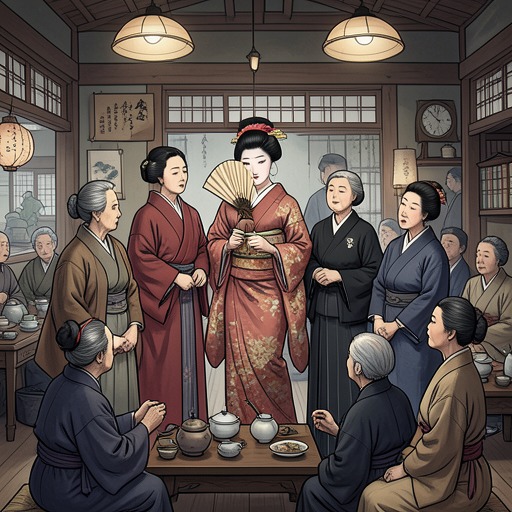
Dr. Crab initially promises to meet Mameha and Sayuri at the Shirae Teahouse, but six weeks pass without word. Mameha later finds him at the Ichiriki Teahouse and learns that he has been occupied with opening a new hospital in Osaka. He proposes renewing his acquaintance at the Shirae the following week. The choice of venue is not incidental: although he is now wealthy enough to attend the prestigious Ichiriki, he has a longstanding bond with the less fashionable Shirae, which he patronizes because it had once been within his means. Sayuri compares his continuing attachment to the teahouse to a man’s inability simply to divorce a former mistress when he takes a new one.
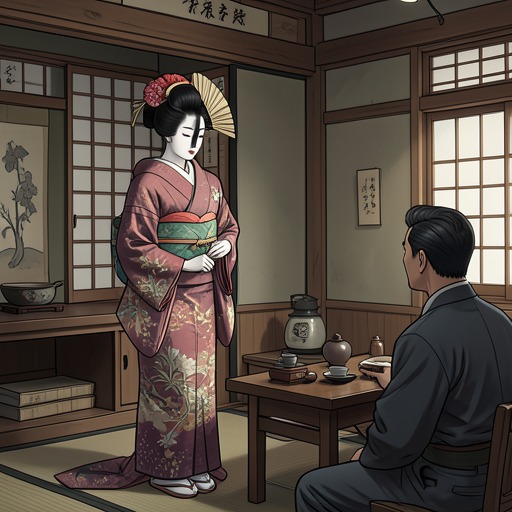
At the Shirae, Dr. Crab remains an awkward, quiet presence. His elbows sometimes bump Mameha or Sayuri, and he turns to nod an apology. He looks down through small, round glasses and slips pieces of sashimi under his mustache, a furtive gesture that makes Sayuri think of a boy hiding something beneath a floor covering. The evening seems to her a failure: he appears to enjoy himself so little that she doubts he will return. Instead, he contacts them the following week and visits Gion nearly every week for months. The contrast between his impassive manner and his regular attendance establishes the persistence of his interest without making him socially fluent or demonstrative.
Mizuage and Mameha’s Strategy
Mameha explains that Dr. Crab is interested in Sayuri for a reason different from the painter Uchida’s artistic attention. The Doctor, like Nobu, is interested in mizuage. Mameha describes him as a man who makes substantial money from his hospital and, after supporting his family, spends it pursuing mizuage. She says Sayuri is precisely the kind of young girl he prefers and explains that she knows his taste because she herself had once been such a girl.
Mameha’s own mizuage supplies the measure of Dr. Crab’s resources and his competitive streak. A year or two before Sayuri arrived in Gion, he paid a record amount for Mameha’s mizuage, perhaps seven or eight thousand yen. Her fame contributed to the price, but another wealthy bidder, the businessman Fujikado, drove it higher. Such bidding was unusual in Gion, where men generally knew one another and preferred to settle matters by agreement. Fujikado, who lived far away and visited only occasionally, had little reason to avoid offending Dr. Crab. The Doctor, meanwhile, disliked self-made businessmen like Fujikado, despite being largely self-made himself. His claim to aristocratic blood thus sits uneasily beside the commercial ambition and social rivalry that helped make his bid exceptional.
For Mameha, this history makes Dr. Crab more than a prospective patron: he is one of the two supports in a plan to catch Hatsumomo off balance, the other being Nobu. Yet the plan depends on keeping the Doctor’s interest alive. His delay after their first meeting worries Mameha, and her anxiety increases during the weeks without news. When he does reappear, his regular visits turn a tentative introduction into an ongoing possibility, even as Mameha steers the meetings away from Hatsumomo by choosing the Shirae.
Social Performance and Emotional Labor
Dr. Crab’s reserved manner contrasts with the practiced conversation that geisha use to manage a banquet. Sayuri observes Mameha respond differently to guests according to their age, arrogance, and uncertainty. When a nervous young man, perhaps nineteen or twenty, can think only to remark on the warmth, Mameha answers with an increasingly suggestive description of stepping out of the bath. His fingers tremble when he sets down his sake cup. The episode shows how Mameha turns even a banal opening into a performance calibrated to a particular guest. Dr. Crab’s own quiet attendance belongs to this world of managed sociability, but the account does not show him attempting Mameha’s verbal playfulness.
Later, during a gathering where the Minister becomes dangerously drunk, Sayuri has to deal with the immediate physical consequences of entertaining a guest. She peels the Minister’s wet socks from his feet while keeping her distance, and he promptly slumps onto the mats and loses consciousness again. Nobu calls him a fool; Sayuri asks whether he could hear them and whether this was the kind of evening Nobu had intended. Dr. Crab is not present in this episode, but its details illuminate the broader labor surrounding patrons and guests: the geisha’s work can extend from conversation and sake service to tending a helpless, intoxicated man. In a later winter and spring, Nobu brings the Minister to Gion once or twice each week. The Minister notices chiefly whether Sayuri is beside him and whether his cup is full, while Nobu grows short-tempered when her attention shifts toward the Minister. Such scenes place the Doctor’s pursuit within a social economy where money and desire are accompanied by performance, service, and competing claims on Sayuri’s attention.
Characterization and Narrative Significance
Dr. Crab’s importance rests on the conjunction of an eccentric exterior and consequential economic power. His protruding elbows, carefully handled door, spare pair of glasses, and hidden sashimi give Sayuri a vivid, faintly comic portrait of him. Yet his record-setting bid for Mameha and his willingness to spend his hospital earnings on mizuage mark him as a serious participant in a system that can turn reputation, preference, and rivalry into money. The contrast prevents the nickname from reducing him to a comic figure: the awkward man in the quiet teahouse has the means to shape a young geisha’s prospects.
His role also helps distinguish different forms of attention directed at Sayuri. Uchida sees her through the eyes of an artist; Dr. Crab and Nobu are drawn to the prospect of mizuage. Mameha’s explanation makes that distinction explicit and uses it to clarify the choices surrounding Sayuri’s future. Dr. Crab’s interest is neither presented as a romantic attachment nor developed into a fuller account of his private life. The evidence instead emphasizes his preferences, wealth, past transaction with Mameha, and usefulness to her design. As a result, he serves both as an individual with recognizable habits and as a figure through whom the narrative exposes the commercial arrangements beneath geisha patronage.